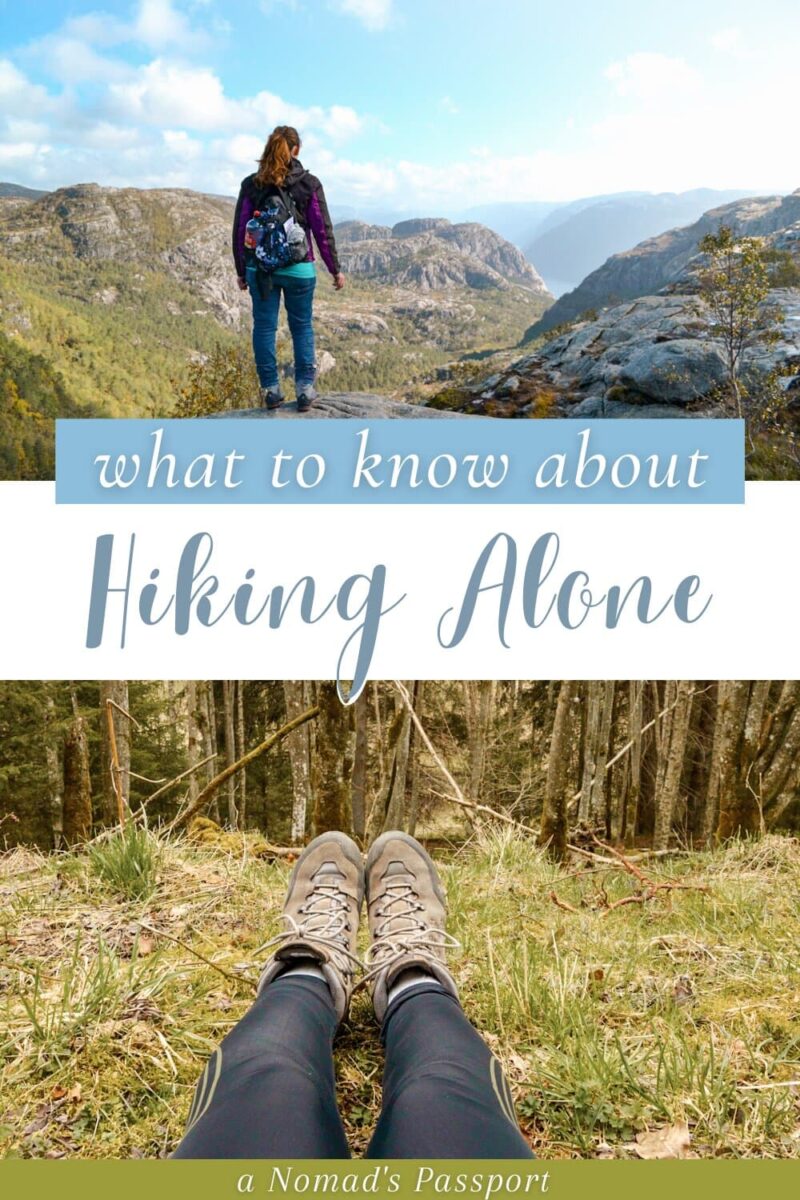
A wide open trail and no sound but the wind, chirping birds and your own footprints – that is why comes to mind when I think about hiking alone. It is the ultimate way to connect with nature and allows you to just be in the moment. Solo hiking allows you to feel the rush of freedom as you are the one that gets to choose where you will go, where you will stop and so much more.
And yet, it is a freedom that does not come without its risks, as the peaceful solitude also comes with a certain danger. Therefore, there are some things to keep in mind when hiking alone. Aside from preparing your hike and packing all essentials, there are things you should do as you are hiking.
You will find a list of all these things to do and some additional solo hiking tips below. These tips apply to newbie solo hikers and solo hiking veterans alike, as mere experience itself does not keep you safe on the trail. So give them a read and ensure that you are safe when you venture out on your own.

Why hike alone
There are many reasons why people hike alone, ranging from the wish to enjoy the sound of silence to having no hiking buddy, or even just the desire to challenge oneself. I, for one, have gone on solo hikes for all these reasons. Sometimes, on my own with my camera as my only companion and other times with my dog.
I love the freedom solo hiking gives me. It allows me to think and reconnect with nature. It is a small break from working that reminds me why I started this adventure travel blog. And it is the closest I can come to feeling like a solo traveler when I can only explore my own region of Germany.
But while I love it, I am only well aware of the dangers that come with hiking alone. Therefore, I want to make the following thing clear:
It is important that you solo hike because you want to, and not because someone told you it is cool or because it is the ‘thing to do’. Hiking alone is not for everyone and that is perfectly fine. The decision is a personal one and should not be influenced by the perception of others.
Tackling a trail alone can be physically and mentally challenging, and should only be done if it feels right to YOU as an individual.

I might love the freedom it grants me and do encourage others to give it a go, but only if said person feels confident enough in their abilities to do it. So please read these solo hiking tips to learn more about what to keep in mind when hiking alone and then make a decision that is the right one for you.
There is no shame in preferring to hike with friends, and doing so certainly has its benefits too. And if you have no hiking buddy, you can always join a local hiking group. It is one of the best ways to make friends in a new city. Hike in a sustainable and ethical manner that makes you happy, as that is all that matters when you start your adventure.
This post may contain affiliate links(*), which means I may receive a commission, at no extra cost to you if you make a purchase through a link. Please see the full disclosure for further information.
Things to do before you hike alone
1. Let someone know where you are going
It is amazing to hike alone, but you should never leave caution at home when you venture out into the wilderness. While not that likely, things could go wrong if you injure yourself or you get lost, so it is always ideal to let someone else know where you are going. This way, someone will know where to send help in case an incident occurs.
It is also a good idea to tell someone when you will be back from your hike and to tell them that you will give them a call or send them a message once you are back at your car or the trailhead. If you do not contact said person on time, they can then inform a ranger station and a search and rescue operation will be organized timely.
Leaving a note with your location and trail information in your car is another solo hiking tip. Especially, if you make any last-minute changes to your route. Just ensure, that you flip the note around so strangers cannot see where you are going if there is not an emergency.
2. Choose a well-known trail that is frequented by others
While off-the-beaten-track adventures are great, they are usually not ideal for a solo hike. At least not, if you are hiking alone for the first time. You might need help at one point or your sense of navigation might be off, so it is ideal to choose a well-marked trail that is frequented by other hikers.

If the trail is well marked, you do not have to stress about accidentally getting lost or ending up on the wrong path, and if there are fellow hikers, you might even make some new friends.
Once you have been hiking alone for a while and are more confident in your navigation skills, you can explore the beauty of more remote areas. Just ensure, that you bring a good navigation GPS device. The Garmin InReach Mini is a good option as it also lets you send your GPS coordinates to others.
3. Research the route in advance
If you want to solo hike, you should familiarize yourself with the route you will be hiking. Doing so ensures that you know what you are in for in terms of elevation gain and total distance, and if there are any particularly difficult passages along the way that might deem the route not ideal for you.
If you study your route in advance, you also know if there are any amenities or scenic detours, so it helps you prepare for a good and safe hike.
4. Know what to look out for in terms of wildlife
There are predators such as bears, wild cats, wolves, and more in many popular hiking areas, so knowing about their existence and how to react if you encounter a wild animal is a crucial step in planning your solo hike. Most regions have very specific behavior recommendations for wildlife encounters, and knowing what to do might just save your life whether you or hiking alone or with friends.
Aside from predators, the forests and national parks that are home to many amazing hikes are also home to a large number of other animals. Therefore, doing some research about the local animal also enables you to know which rare sight you might want to keep an eye out for and if there is a specific area with a greater chance of spotting unique animals.
5. Check the weather & other warnings
It is always crucial to check what the weather will be like before you start your hike. Furthermore, you should check if there are any additional warnings that might impact your hikes like an ongoing bushfire or a flood warning.
If you are hiking on your own this step is crucial, as you cannot rely on anyone else to do it for you.
It is okay if it starts to rain while you are hiking, but if the forecast predicts a thunderstorm, it is best to reschedule your hike.
If you are a photographer like me, you might also want to check out what the cloud cover will be like. After all, the clouds will have a large impact on the light conditions.

To get all relevant information about the weather, I use the Clime app of the NOAA, which is a weather radar app that displays everything from rain showers to thunderstorms and wildfires. There is a free version, but the annual subscription of 20.49€ is well worth it. It’s available for iOS and Android.
Additionally, I usually check the Windy.com data before setting out on a solo hike.
Solo Hiking Tips: Essentials
6. Use a navigation aid
If you want to hike alone, you have to download the route or bring a map. Otherwise, there is a good chance that you will get lost – especially if you have yet to train your navigation skills.
Another crucial thing to do is to ensure that your map is correct. Not doing this was one of my more recent hiking blunders and could have easily been a fatal travel mishap. After all, I nearly ended up in an active military training area where shots were fired with live ammunition. Be sure to use an updated trail map and do not just trust every route you find on popular hiking apps.
If you solo hike a lot, it might be a very good idea to buy a Garmin Inreach Mini, as it allows you to track your location and also send the GPS data to family and friends.
7. Pack enough food and water
Once you have started your hike, there is a good likelihood that you will not get the chance to buy water and snacks until you have reached the end of the trail, Therefore, you have to ensure that you have a sufficient amount of water and snacks on you.
When hiking alone, there is no one that might be able to give you some of their water or food, so think about what you need for your chosen trail and then pack some more as an emergency ratio. I usually take at least 2 liters with me when I am planning a shorter hike but for longer hikes or on warm days 3 liters are better.
If you do not want to carry an insulated bottle, you can also opt for a water bladder that decreases in size as you drink. Should you plan a very long or multi-day hike or explore very remote areas, you should also consider bringing a LifeStraw as it allows you to safely drink from natural water sources.
Buy your hiking essentials now
8. Wear suitable clothes & bring additional layers
Wearing suitable clothes while hiking is always crucial, but even more so when you are hiking alone. After all, you have no hiking buddy that might be able to lend you a spare scarf, hat, or gloves.
Keep in mind, that it is a good idea to bring a scarf, a hat, and gloves even if it is sunny if you will gain altitude while hiking. After all, the air near the top of the mountain is colder and the wind in open areas feels chilly.

The weather could also change while you hike, so it is always a good idea to pack at least a thin rain jacket. I prefer 2-in-1 rain jackets with a softshell layer that can be separated from the waterproof outer jacket.
When I hike, I tend to wear an onion look, as it allows me to take off things if it gets too warm and put them back on as soon as I start feeling cold. I can only advise you to do the same unless you are hiking in tropical climates or exploring Australian national parks like Karijini.
9. Bring an emergency kit
Accidents can happen while solo hiking, so having an emergency first aid kit on you is a necessity. The most commonly used items are blister bandages, so ensure that you have some on you. Other useful items are bandaids, bandages, sterile gauze, something anti-septic, and antihistamines.
In addition to that, I now also put some bigger waterproof bandaids in my solo hiking emergency kit. After all, I do not want a repeat of the aftermath of my trip to the Banya Wana Amertha waterfall.
10. Bring a charged power bank
For some unexplainable reason, phone batteries have the annoying habit that they are always empty when you need your phone the most, and that is the last thing you want while hiking. Especially, if you desperately have to use your phone in an emergency situation. Therefore, bringing a fully charged power bank is a good idea when you are hiking alone.
They do not weigh much and it might even be worth it to pack two just to be on the safe side. If you do, you will not have to worry about using your phone as a navigation device or taking a lot of photos and videos with it.
Depending on your camera model, you might also be able to use the power banks to recharge your camera. Just ensure, that you have the cable of your GoPro or another action cam on you.
Crucial Tips for Hiking Alone
11. Stay within your comfort zone & accept your limits
I believe that this one is the most crucial solo hiking tip or rather rule, as things tend to go wrong when you try to exceed your limits while hiking alone. There is no need to push the limits when you are already doing something that comes with a certain risk.
So know how far you can hike without being exhausted and if there is anything you struggle with, and select a trail based on that. Do not hesitate to walk back or cancel the hike if you do not feel up to it or encounter a part of the hike that you do not feel comfortable tackling.
And under no circumstances hike alone just to prove something to someone. There are many reasons to solo hike, but pushing yourself outside of your comfort zone for this reason is never a good idea.

12. Routinely look back
While you should look at the trail ahead of you, it is also important to routinely look back while hiking alone. After all, the area looks completely different from a different perspective, which means you likely would not recognize landmarks from another angle. By looking back, you will know what the landscape and significant location markers look like when following the trail in the opposite direction.
While it might appear useless at first glance, it can be really helpful and save you a lot of trouble if you have to backtrack for some reason. This simple solo hiking tip drastically reduces the chances of you getting lost. Thanks to looking back, you will know which trail to follow if there is a split in the trail or if a part of the trail is not clearly visible.
Also, consider taking photos of prominent features or waymarkers so you can use them as an orientation aid if you get lost and are in an emergency situation.
13. Do not listen to music
I have to admit that I am somewhat guilty of this myself, as I occasionally like listening to musing when solo hiking, as it can be a great motivation. However, doing so is not without risks, which is why I do not recommend it. When hiking alone, you want to be able to hear what is going on around you as that is the only way to know if there are animals, other hikers, or even a rockslide outside of your field of vision.
If you listen to music, you are isolating yourself from your surroundings, so you will also not hear someone calling for help. And while you might have alone to enjoy the solitude, you should definitely always be prepared to help others that are doing the same thing as you.
Additionally, you will also not hear if another human approaches you from behind. And while this is usually not an issue, it has to potential to be a dangerous situation – especially if you are a woman that is hiking alone. Do yourself a favor and do not risk listing to music with two earplugs in while you hike or at a loud volume.

I personally think that quiet ambient music and one earplug are usually fine as it still allows me to hear what is going on around me.
However, there are plenty of scenarios where I would not do so including while hiking in an area with major predators.
Know, that this is my personal stance and that every single solo hiker should think of the downsides of listening to music before deciding what is best for him or her.
Solo Hiking FAQ
Is it a good idea to hike alone?
Let’s say it like this: As long as you know what you are doing and abide the basic safety rules of hiking alone, it is a good idea to solo hike. Just ensure, that you do it for the right reasons and not because someone else is pushing you to do it.
Keep in mind that it is not a good idea if you have no prior hiking experience. It is crucial to know your own limits and have some navigation skills if you want to take a trail alone. So gain some experience before you set out on your own.
How do you protect yourself when hiking alone?
The best way to protect yourself while hiking alone is by knowing what to expect and by being prepared. Always research the trail before you hike and know your own skill level. Do not tackle trails that are too difficult or super remote if you are solo hiking. And of course, you should also bring something you can use to protect yourself against animals or others that could endanger your life and well-being.
Can a woman hike alone?
Yes, a woman can hike alone. As always, there are more things to keep in mind, so it does not hurt if you bring pepper spray and know some basic self-defense. Aside from that, solo hiking for women is no different than for men.
What should I bring on a solo hike?
What you should bring on a solo hike partially depends on where and when you will be hiking, and of course, also how long the hike will be.
However, you should bring the following items: suitable hiking boots or shoes, a first aid kit, a means of navigation, a sufficient amount of water, some snacks, and something to keep you warm.
Additionally, it is a good idea to have a GPS that allows you to send messages in an emergency situation.

Are you planning a trip?
Check out these useful websites and resources I use to plan my adventures around the world.

Roundup: The Best Solo Hiking Tips
It is great to hike alone, but it is also a challenge, as you are the sole person responsible for your safety and well-being. The mere idea alone can be daunting. And yet, the freedom it grants you is worth it.
It is a hobby that comes with a certain risks, so it is crucial to abide the safety rules and tips when planning to hike alone. No adventure, no matter how great it might be, is worth your life. So do your research and be prepared for the trail you are tackling. That way, you will also be able to enjoy the hike itself much more, as you will not be struggling due to being unprepared.
At the end of the day, all that matters is that you are safe while out on the trail and have a great time. Hopefully, this list of solo hiking tips will contribute to that.
More about Hiking
If you love hiking, you might also be interested in these hikes:
Preikestolen Hike
Roque Nublo Hike
Do you have any other solo hiking tips?
Let me know in the comments down below!
Do you like solo hiking?
Pin these solo hiking tips!