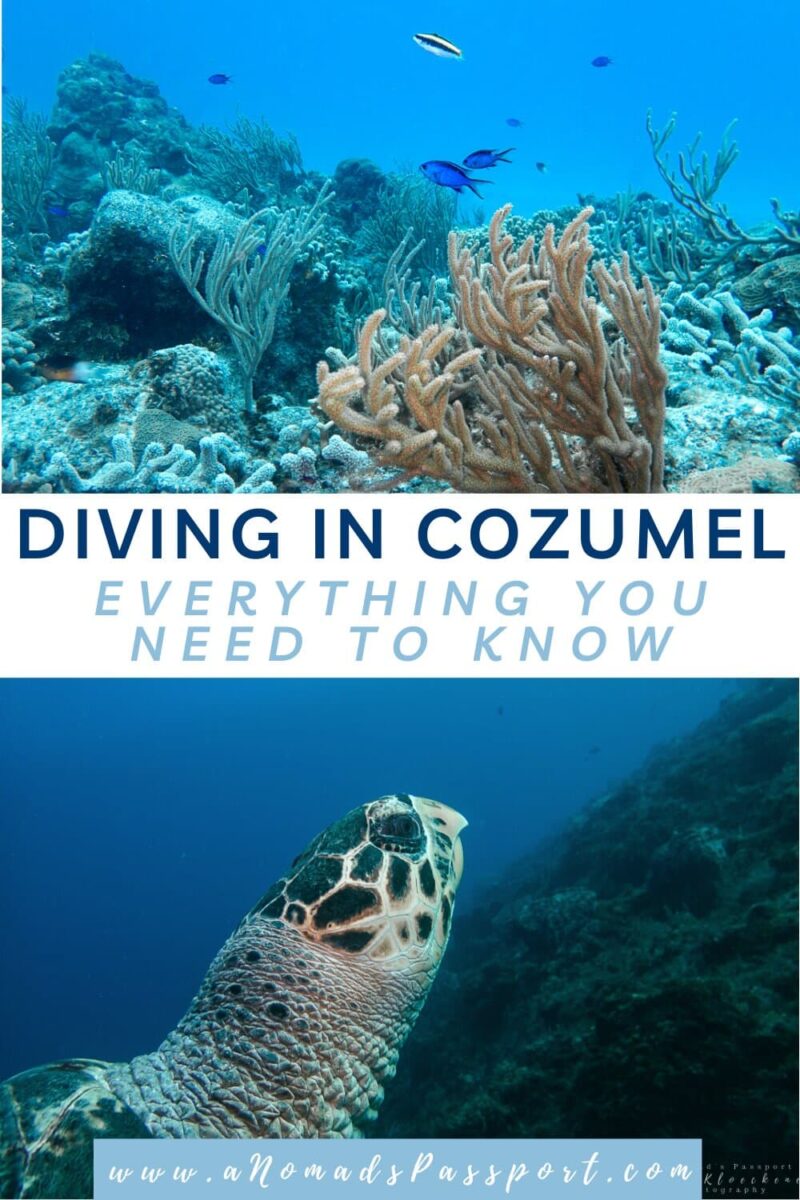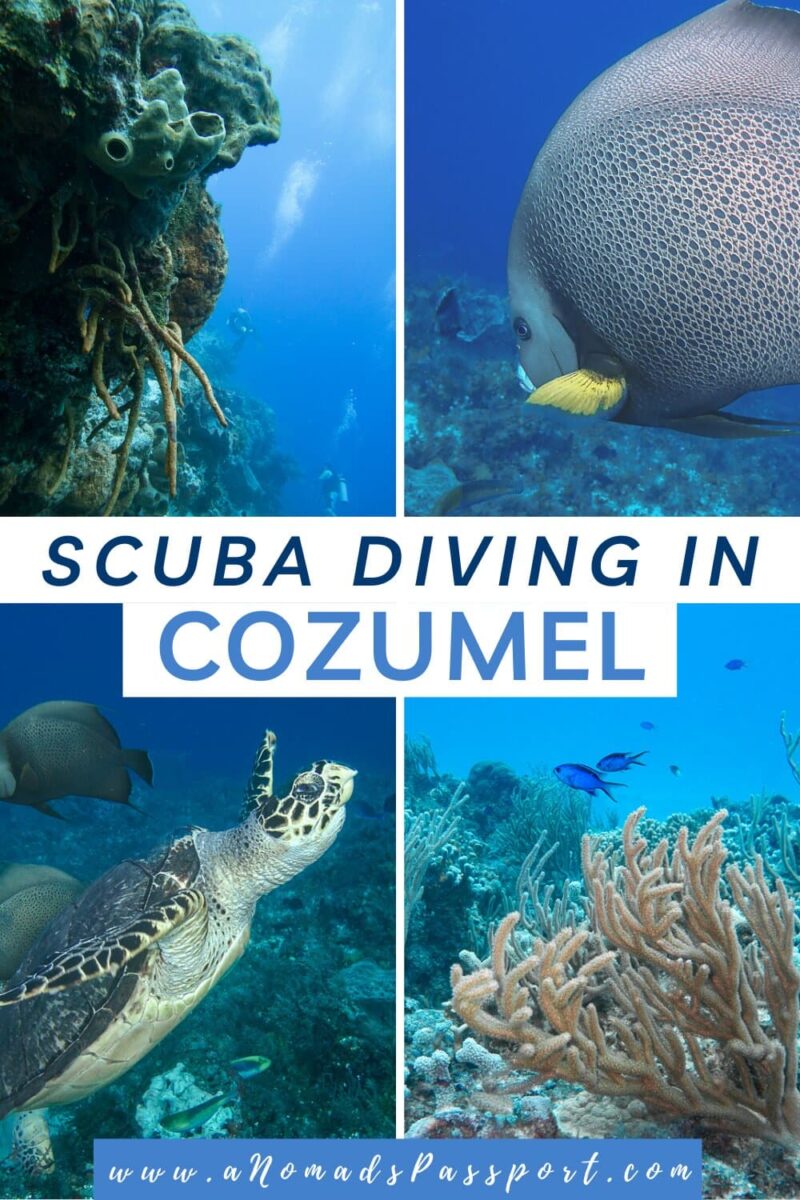
Towering corals, parrotfish that are nibbling on colorful corals, and Cozumel splendid toadfish that hide in crevices – Cozumel is a real paradise for divers no matter how experienced they are.
Known for its drift dives past walls that are flourishing with life, this island and its underwater world are not to be missed if you are a passionate scuba diver. After all, you get the perfect combination of reef dives and wall dives with swim-throughs, and there is even a wreck dive.
Admittedly, diving in Cozumel was not my main incentive when I booked my flights to Mexico, but I knew that I had to hop over to Cozumel during my month of living in Playa del Carmen. After having to push back the Cozumel diving trip due to a storm and a consequent harbor closure, I was slightly worried when I saw the weather report for the new dates.
But thankfully, the harbor remained open, and I got to scuba dive in Cozumel for two days. And while the rain was hiding some of Cozumel’s beauty behind a curtain of rain, this no longer mattered within the course of one backroll. Suddenly, I was surrounded by a vibrant underwater world that made the rainy boat ride to the dive site more than worth it. Despite the weather, diving in Cozumel did not disappoint and more than met my expectations.

Disclosure: This post about scuba diving in Cozumel is based on a press trip. As always, all opinions expressed in this post are my own and not influenced in any way.
This post may contain affiliate links(*), which means I may receive a commission, at no extra cost to you if you make a purchase through a link. Please see the full disclosure for further information.
About Scuba Diving in Cozumel
Diving in Cozumel is all about drift diving, wall dives, and colorful corals, and of course, there are also caves formed by corals at Palancar Reef near the southern tip of the island. The warm Caribbean water has an intense blue coloration and the visibility is amazing. This combination makes diving here some of the best diving in Mexico and one of the best diving destinations in the world.
Combined with diving in cenotes on the mainland, diving in Cozumel makes for one of the most diverse and breathtaking diving holidays you can imagine.
The coral reefs of Cozumel are part of the Mesoamerican Reef System, which is the largest reef system in the Americas and the most extensive barrier reef system in the Western Hemisphere.
In its entirety is home to 1,192 marine species. Some of them are endangered and there are also endemic species.
Large parts of the area around Cozumel are part of the Cozumel Reefs National Park (Parque Nacional Arrecifes de Cozumel).
Founded in July of 1996, this protected area has a size of 11987.88 ha. It starts just south of the cruise ship pier and then wraps around the Southern tip and up the wilder east coast of Cozumel to Punta Chiqueros.

It is thanks to the establishment of this protected area that the reefs of Cozumel are thriving, and there are continuous measures to further protect the marine biodiversity. So please be a responsible diver and follow all the rules when diving in Cozumel.
Currents in Cozumel
Diving in Cozumel is drift diving and there is a prevalent South to North current. Hereby, the currents in the North are usually stronger than in the South. While the current in the deeper reef parts is usually around 3 knots, some dive sites in the North, namely San Juan & Baracuda, have currents up to 6 knots or more.

Additionally, the current is less strong on the shallower inner reefs. The current is also not always the same throughout a dive site, so do not be surprised if you suddenly encounter a much stronger current or notice that the current is suddenly reversed.
While the information above describes the status quo, the currents can be different as the weather (lows and highs) in the region impacts them. This is especially the case if there is a tropical storm or even hurricane in the wider area.
In some areas, the direction of the current is also affected by the shape of the seabed and shoreline itself. This means it is a good idea to have a dive guide that knows the reefs well.
Visibility
Most of the time the visibility underwater is amazing. The average visibility is around 150 ft (46 meters), but it can vary from 80 – 250 ft (24 – 76 meters). However, this is not always the case as storms in the area can severely impact the great visibility Cozumel is famous for.
While there, I also encountered what looked like an underwater sandstorm that started as a trickle that could have been started by someone’s unfortunate fin movement and then turned into a sand wall. It was still possible to see, but we ended up moving to a different part of the reef.
The Best Time to Dive in Cozumel
Diving in Cozumel is fantastic year-round, and on average, there are around 300 days a year when it is possible to dive. Therefore, the best time to scuba dive in Cozumel mostly depends on what exactly you are looking for.
It is important to keep in mind that there can be storms at any point during which diving is not possible. However, these storms rarely stop you from diving for more than a day or two.
From November to April, the storms that can impact your trip are ‘Norte’ storms with strong winds, while the storms between May and November are tropical storms that can come with heavy rain.

There is a chance of bigger disruptions during the hurricane season from July to November, but the last hurricane that directly hit Cozumel was Hurricane Wilma back in 2005.
The high season from December to March is Cozumel’s eagle ray season, and also the time to visit the mainland to dive with bull sharks in Playa del Carmen.
The turtle mating season lasts from May to September, which makes it the best time to dive in Cozumel if you want to see a lot of loggerhead turtles, hawksbill turtles, and green turtles. If you also want to dive in cenotes and are hoping to see the most stunning light effects, late April to mid-June is ideal.
September to November mark the off-season. During this time, the dive boats are less crowded, which usually makes it easier to visit exactly the dive sites you want to explore. However, these months are also very hot and humid, and still within the hurricane season.
Based on my experience, I would say that May is a great month. While I did not have the best weather when visiting Cozumel, it was all due to two storms, and aside from the two time frames for my Cozumel diving trip, the weather was more than amazing.
And while I would have loved to have had sunny weather, it ultimately does not matter, if it is raining. Just do yourself a favor and bring a windbreaker so you do not get cold during the surface interval.
Water Temperature in Cozumel
The water temperature in Cozumel is relatively stable throughout the year. As everywhere in warmer climates, very shallow areas are often slightly warmer than deeper areas. The figures in the table are a monthly average, and colder or warmer water temperatures are possible.
While the average monthly water temperature sees little change, it can be noticeably colder on some days depending on the weather and currents.
During my four dives in Cozumel on two days, I encountered temperatures ranging from 26.7°C to 27.8°C. Hereby, the dives were at similar depths, and the water was warmer on the first day.
| January | February | March |
| 26 °C 78.8 °F | 26 °C 78.8 °F | 25 °C 77 °F |
| April | May | June |
| 26 °C 78.8 °F | 27 °C 80.6 °F | 27 °C 80.6 °F |
| July | August | September |
| 28 °C 82.4 °F | 28 – 29 °C 82.4 – 84.2 °F | 28 – 29 °C 82.4 – 84.2 °F |
| October | November | December |
| 28 °C 82.4 °F | 28 °C 82.4 °F | 27 °C 80.6 °F |
Cozumel Reef Closure 2024 by Month
Back in late 2019, a reef closure rotation was implemented in the Cozumel Reefs National Park to help protect the reefs and to give them a recovery period.
The closures affect a few dive sites for the duration of two months and rotate throughout the year. As only a few dive sites are closed at once, there will still be plenty of amazing dive sites in Cozumel you can explore. Be sure to plan your Cozumel diving trip accordingly if you dream of diving at a specific site.

The regular Cozumel Reef closures in 2024 are as follows:
- December & January: Chankanaab Bolones & Chankanaab
- February & March: Paso del Cedral & Francesca
- April & May: Punta Dalila, Palancar Jardines (Gardens) & Palancar Herradura (Horseshoe)
- June & July: Paradise Reef
- August & September: Palancar Cuevas (Caves), Palancar Ladilllos (Bricks), Columbia Shallow, Columbia & Columbia Deep
- October & November: San Francisco Wal & Santa Rosa Wall
Usually, the reef closures remain the same on a year-by-year basis, but you can double-check the dates on the “Parque Nacional Arrecifes de Cozumel y APFF Isla Cozumel” Facebook page.
Dive Sites in Cozumel
Cozumel offers a large variety of dive sites ranging from famous wall dives with swim-throughs to reef dives and even a wreck dive. There are suitable dive sites for all levels, which makes this island the ideal scuba diving holiday destination if you are traveling with your entire family.
During my first Cozumel trip, I only had the opportunity to explore four of them. However, I love the island and diving there, so I will definitely return there to check out all the other dive sites Cozumel has to offer.
While most dive boats offer the divers on the boat to choose the dive sites of the day, it might not be possible if the conditions do not allow safe diving. Additionally, there are monthly reef closures to keep in mind when choosing which Cozumel dive sites you would like to explore.


San Francisco Wall
my dive data: max. depth: 25 m — dive time: 49 min
San Francisco Wall is a sloped wall dive that is best for advanced divers. The top of the wall starts at around 12 meters and gently drops down. It is covered in big brain corals and there are plenty of sponges.
If you dive here, you should keep in mind that the currents can be unpredictable. So keep your eyes open while observing the fish that call this dive site their home.
Santa Rosa Wall
my dive data: max. depth: 18.3 m — dive time: 63 min
Many consider Santa Rosa Wall the wall dive in Cozumel one has to include in their diving itinerary. While its top is between 12 and 18 meters (40 to 60 ft), it drops down nearly vertically. There are a series of swim-throughs that connect the wall and sandy areas, and there are also plenty of overhands and crevices.
Given that this dive site tends to come with strong currents and its depth, it is only suitable for advanced divers. If you realize that the currents at one point are too strong for you, you can use the swim-throughs to escape them. In fact, this is what our dive guide made us do when the current suddenly picked a lot in one spot.


Paso del Cedral
my dive data: max. depth: 24.1 m — dive time: 63 min
Paso del Cedral is a dive site for advanced divers, as the currents range from moderate to strong. I personally consider it a wonderful dive site for photographers, as there are schooling fish, but also a lot of smaller marine life that hides in the corals and sponges.
Some divers say that Paso del Cedral is the best spot to see the Cozumel splendid toadfish. Good dive guides will help you find them, but keep your eyes open for lines that the toadfish’s beard drags into the sand.


Punta Dalila
my dive data: max. depth: 16.5 m — dive time: 61 min
Punta Dalila might not be one of Cozumel’s famous wall dives, but it is rich in marine life. In fact, it is a dive site where you have a good chance of encountering nurse sharks and big green moray eels. The coral formations are not particularly high, but there are plenty of colorful sponges and corals.
Given that the current tends to be milder than at other dive sites, it is a good spot for underwater photographers. It is a dive site that is good for newer divers.
While diving at Punta Dalila, I had the chance to see a nurse shark hunt. In total, our group got to spend at least 5 minutes around it as it was swimming in and out of crevices to look for food.


Cozumel Diving Costs
When compared to cenote diving, the costs of diving in Cozumel are significantly lower. A double boat dive with a reputable dive center costs between 90 to 98 USD, whereby most include the national park fee in this price.
If you plan to dive for several days, many dive centers offer a discounted rate. Hereby, you can expect prices between 80 USD and 83 USD for a double boat dive if you are booking at least five diving days.
Nitrox and rental gear are usually not included in these diving prices in Cozumel. Additionally, most dive centers including Sharky’s Scuba have an extra charge for some dive sites in the very North or South of Cozumel.
Great Dive Centers in Cozumel
There are dive centers all over the place when you walk through San Miguel de Cozumel and additionally, many hotels also have their own dive centers.
When choosing a dive center in Cozumel, you should always cross-reference that they are on the list of authorized operators that have permission to offer scuba dives in the marine park (Cozumel Reefs National Park).
Sharky’s Scuba
While in Cozumel, I was diving with Sharky’s Scuba and loved it. The team treats you like family and the entire crew is very professional. While they are a newer dive center, the team has over 60 years of combined diving experience.

During the dive, the dive masters will point you toward the very best spots and it is obvious that they have detailed knowledge of the reefs. Additionally, they are more than amazing at spotting the Cozumel splendid toadfish.
They let your group dive until the first one in the group only has 50 bars left, so you can easily enjoy Cozumel’s amazing underwater world for an hour. Three of my four dives were slightly longer than an hour.
During the surface interval, the team offers a wide selection of food including fresh fruit. On sunny days, the surface interval is at a beach, but on rainy days it is spent on the boot as it has a roof.
While the weather was miserable and I was freezing on the boat when I was diving with them, they still made it a fun experience and went above and beyond to make everyone onboard happy.

Cozumel Diving Rules
When diving in Cozumel, there are a few rules you have to follow. Please be a responsible diver and abide by them. After all, they are in place for a reason.

Do not use sunscreen. As part of the Healthy Mayan Reef initiative, not even reef-safe sunscreen is allowed.
Do not hold on to the corals.
Do not feed the marine animals or throw anything into the ocean.
Do not take anything you see underwater unless it is trash.
Do not bring knives or gloves.
Spears or other fishing equipment are forbidden inside Cozumel Reef National Park.
What can you see while diving in Cozumel?
Aside from the towering coral structures that Cozumel is known for, divers also encounter a plethora of marine life. Hereby, the Cozumel splendid toadfish is a must-see. While it is not just endemic to Cozumel as once thought, this little fellow is more common in the reefs off the island. Be sure to ask your dive guide to point them out.
There are many damselfish, honeycombed cowfish, and angelfish, including rock beauty angelfish and grey angelfish. Other common sights include nurse sharks, turtles, green moray eels, and spotted moray eels. Seasonally, there is also a high chance of seeing spotted eagle rays.


Cozumel Scuba Diving Packing List
While it is possible to rent good scuba diving gear in Cozumel, I always recommend bringing your own gear as it allows you to dive with the configuration you are used to.
If you are bringing your own gear, you should bring the following:
As always, you should bring your mask, BCD, and regulator set. Having a snorkel is also a good idea as the island has some great snorkeling spots.
Fins that are good when diving in strong currents, as the currents in Cozumel can be unpredictable.
Depending on the time of the year and if you do not get cold too easily, you only need a stinger suit or a 3 mm wetsuit. In the winter months, it is best to dive in a 5mm wetsuit.
As you are diving in open water and might also encounter strong currents, every single diver that is diving in Cozumel should have his or her own SMB and reel.
You might also need a din-to-yoke adapter.

Due to the currents, I want to appeal to you to leave your camera or diving phone case at the hotel if you have not yet mastered your buoyancy skills or have poor situational awareness while taking photos
Things to know about Diving in Cozumel
How long to stay in Cozumel?
If you want to see the bare minimum of what Cozumel has to offer, divers should plan to spend at least a week in Cozumel. By doing so, you can explore a wider variety of dive sites and also have the chance to see what else Cozumel has to offer.
In addition to that, it also has the benefit that you will get the chance to dive even if the harbor master closes the harbor for a few days. After all, the harbor is rarely closed for more than three days.
Should you have more time, you can also spend much longer in Cozumel. I, for one, would not mind spending an entire month there so I can explore every beautiful corner and dive site this island has to offer.
How to get to Cozumel?
Cozumel has its own international airport and there are some direct flights from the USA, Canada, and Mexico. Alternatively, you can also charter a small airplane that will take you from Cancun Airport to Cozumel.

Most people, however, will get to Cozumel by ferry. There are two ferry lines that connect the island and Playa del Carmen and it is a relatively short ride. There are no weight restrictions, which makes it the ideal option for scuba divers visiting Cozumel.
To reach the ferry pier in Playa del Carmen, you can take the ADO bus, arrange a private transfer, drive a rental car, or take a taxi. Hereby, the best option depends on where you start your diving trip to Cozumel.
Read this post for more information: Getting to Cozumel from Cancun (Airport), Tulum & Playa del Carmen
Does Cozumel have a Hyperbaric Chamber?
Cozumel has a hyperbaric chamber which makes diving in Cozumel particularly safe as you are never far from a chamber if there is a diving-related accident. Ensure that you have diving insurance so you do not end up having to pay for the treatment yourself if you have a diving accident.
Scuba Diver Itinerary for Cozumel
While Cozumel is a scuba diving paradise, the island also offers a lot more. Therefore, you should definitely spend at least three days exploring the landside activities and also go snorkeling.
Given that you will likely fly back, it is best to plan to do landside activities near the end of your trip, but if the harbor is closed and diving is therefore not allowed, you can always adjust your schedule and do a landside day.
If you have one week in Cozumel, I recommend the following itinerary:
Day 1: Explore the San Gervasio Ruins & learn more about Mayan culture at Pueblo Del Maíz
Day 2 – 5: explore Cozumel’s underwater world and explore a variety of dive sites
Day 6: Visit Punta Sur Eco Beach Park & drive along the East coast
Day 7: El Cielo Snorkeling Tour & Cozumel Museum

Ideal Accommodations for Scuba Divers
The dive boats of many dive centers pick you up from the jetties of hotels, which means it is best to stay in a hotel that has its own small pier. Otherwise, you will have to pay a usage fee to access the jetty of a nearby hotel.

The El Cid La Ceiba is one of the hotels with its own jetty and also has its own dive center. Located a short drive south of San Miguel de Cozumel, this hotel has spacious rooms with a big bathtub in which you can rinse off your dive gear.
The breakfast opens early and is close to the jetty, which allows you to grab a bite before scuba diving in Cozumel. There is a wide selection that includes local to international options.
While many hotels that are great options for scuba divers have their own restaurants, it is worth it to take a taxi to San Miguel de Cozumel. It’s where many of Cozumel’s best restaurants are located, and you miss out if you do not eat there. Novena Ola is located inside the Cozumel Museum and is the best restaurant if you want to watch the sunset.
Are you planning a trip?
Check out these useful websites and resources I use to plan my adventures around the world.

Roundup: Diving in Cozumel
Cozumel is a paradise for scuba divers and should be on every diver’s bucket list. After all, it is among the best Caribbean diving destinations as well as being very easy to reach. And of course, the island offers much more than just an astonishing underwater world with vibrant coral walls and plenty of marine life. It is the ideal destination for a week or more of scuba diving alongside some landside sightseeing.
Scuba diving in Cozumel is one of those things you would not mind doing again and again, as there is so much to see. I, for one, cannot wait to return there in order to explore all the other epic dive sites of Cozumel.
More about Cozumel
If you love diving, you might also be interested in these posts about scuba diving:
Snorkeling vs Diving
Why Learn to Dive
What do you like the most about diving in Cozumel?
Let me know in the comments below!
Planning a Cozumel Diving trip?
Pin This Diving in Cozumel Guide for later!