
There are many reasons to learn to scuba dive, and I could easily talk about them for days without running out of new things to say. After all, diving is amazing, and becoming a certified scuba diver opens up a world of wondrous new possibilities.
The second you learn to dive, you embark on an amazing journey that will let you dive into a new environment that is full of wonders. It is a neverending adventure and can be the starting point of the journey of a lifetime.
It might come as a surprise, but I never dreamed of learning to dive. But when I moved to Australia, I decided to get certified, as the Great Barrier Reef had always been on my bucket list.
And then I jumped into the ocean with a tank attached to my back for the first time during my OWD course, and I was hooked. I went from “let’s only dive in the GBR” to “which other places in the world have amazing dive sites” in the blink of an eye.
Since then, I had the chance to dive all around the world, and every single dive makes me fall further in love with the underwater world. I just wish that someone had told me of these reasons to become a certified scuba diver, so I would have learned to scuba dive earlier.

1. You will know what it feels like to fly
Scuba diving is the closest you can get to flying. Once you have put on your scuba gear and jumped in the water, it can feel like there is nothing around you. You are seemingly weightless, and you move slightly up and down with every breath you take. It is the ultimate freedom of movement.
If there is nothing you could bump into, you can twirl around and just have fun. I like to do so during the safety stop when I have to maintain a certain depth for three minutes.
However, there might also be video proof out there, that I sometimes just spread my arms while diving and pretend that I am actually flying.
This was what initially made me want to keep diving after learning to dive, and I think that most divers love this feeling of weightlessness as well.

2. You get to see things most can only dream of
71% of our planet is covered by water, with 96.5% being oceans. Therefore, there is a lot hidden beneath the surface that is exclusive to those that can dive or that own a submarine. Given that you likely do not have your own submarine, this means you have to learn to scuba dive in order to see the wonders of the underwater world.
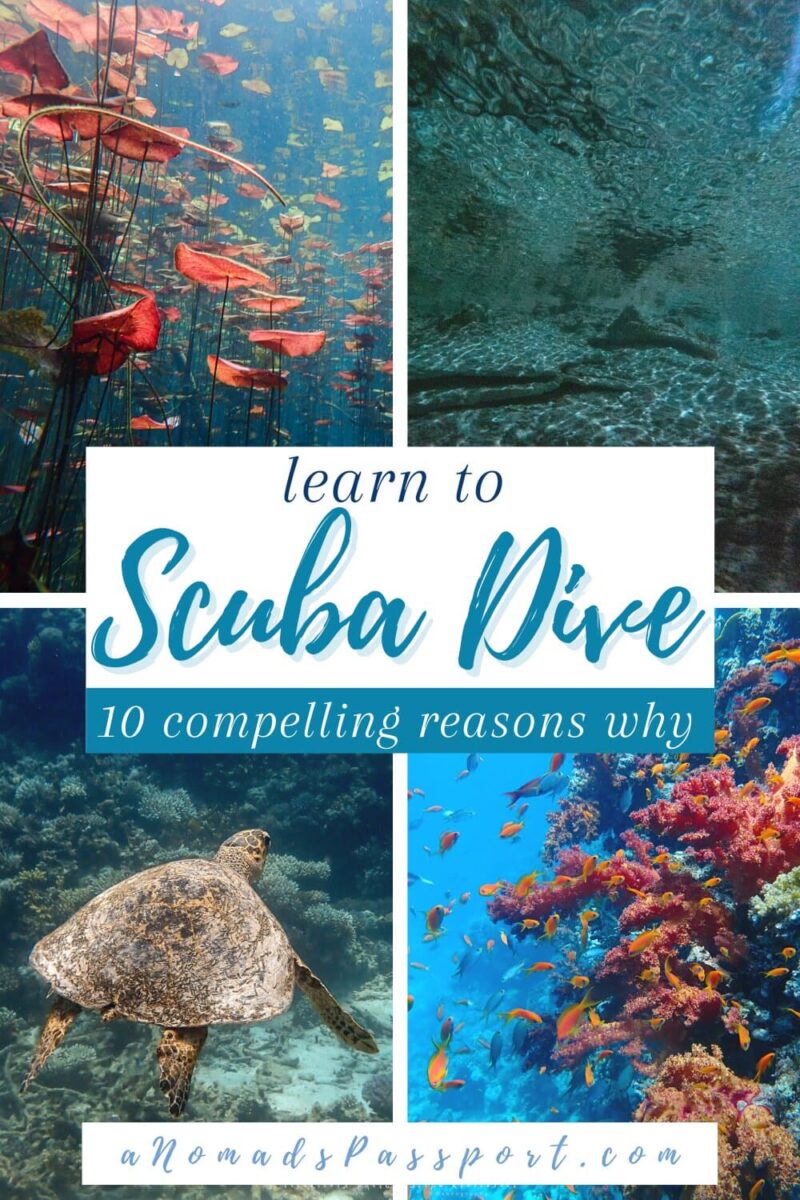
Diving allows you to see vibrant coral reefs that are full of life, with turtles gliding over the reef as rays rest on the sandy ground. And once you have gained some experience and have extended your training, you can also dive in cenotes like Cenote Angelita with its spooky hydrogen sulfide layer or Cenote El Pit with its magical light beams that penetrate the water on sunny days.
Regardless of where you dive, you will discover that it is a wonderous world that offers those that dare to explore it, experiences beyond their wildest imagination. And while some might dream of seeing these sights after watching a documentary, you will be able to experience them after learning to dive.


3. The mesmerizing wildlife encounters
The many ethical animal encounters are another reason to learn to scuba dive. While it is possible to snorkel with turtles in places like Cape Range National Park (Western Australia) or Akumal (Mexico), it is even better to observe a turtle while diving. You do not have to worry about holding your breath and can spot turtles at greater depths than while snorkeling.
Over the course of the years, I have seen many turtles, and let me tell you that it never stops being special to observe one of them eat or just glide through the water.

Other fantastic animal encounters while scuba diving, are those dolphins and sharks, and after a while, you will realize that many sharks are mere curious puppies of the ocean. Depending on where you are diving, you might also encounter seals and manta rays.
Divers that are extremely lucky might just see the world’s largest fish, the whale shark. An encounter, that is even more magical than merely swimming with whale sharks near Isla Mujeres.
4. You meet amazing people in the diving community
Aside from aquatic animals, learning to dive also means you encounter fellow divers and make new friends. Given that all divers share the same passion, you automatically have something to talk about when you meet, and after a few dives together, there are bound to be inside jokes and funny stories.
While not every diver will be the ideal dive buddy for you, there will always be something you can talk about. Therefore, joining a dive club is one of the best ways to make friends in a new city.
One of my fondest memories of meeting new divers was during my first liveaboard. I ended up joining the trip as a solo traveler, and nearly everyone knew at least someone else onboard. And yet, everyone sat together like friends at the end of the first day to look at the photos of that day’s dives.

Freebie: Liveaboard Packing List
5. You get to explore sunken chapters of history
The oceans and lakes are full of sunken pieces of history such as wrecks of ships and airplanes, and even sunken cities. Therefore, diving allows you to explore parts of world history that many only ever hear about.
Popular wreck dives include the SS Yongola (Queensland, Australia), the SS Thistlegorm in the Red Sea, and the Fujikawa Maru in the Micronesian Truk Lagoon. Malta is famous for its wreck dives and is a good starting point if you are a newer diver.
There are many sunken cities and structures all over the world, which means it is worth it to learn to scuba dive if you love history. Once you are a certified diver, you can explore the sunken Baiae in Italy with its pristine mosaics or Thonis-Heracleion off the coast of Alexandria in Egypt.
In addition to places that vanished beneath the waves due to natural disasters, there are also places like the Soviet Rummu Prison in Estonia, which now lies in a quarry.


6. It is an amazing thing to do while traveling
Scuba diving is both something to do while traveling and a reason to travel. Once you have learned to dive, you might suddenly notice that there are a lot of dive centers on the island you have been visiting for yours for your annual beach vacation. Suddenly, there is more you can do during your vacation, and you can explore a new aspect of a place you already love.
If you routinely go on vacation in Egypt, you definitely should plan a few days of diving in the Red Sea. The same also applies to the Canary Islands, as there are great dive sites in Gran Canaria and the other islands.
The same also applies when you plan a vacation to a new destination, as there are great diving opportunities all around the world. If you are planning a Western Australia road trip, you definitely should add diving the Ningaloo Reef to your itinerary, and if you are heading to Mexico, you should not miss out on diving in magical environments like Cenote Car Wash.
Diving is the perfect addition to a well-rounded vacation, so I recommend learning to dive ahead of your next trip abroad.


7. You enter a peaceful environment away from the stress of life at the surface
Aside from the occasional sound of a boat motor, there is usually no noise once you are underwater. As long as you do not have a full face mask with a microphone and speaker, there is no talking, which makes diving the perfect activity if you want to get away from the stress of your everyday life. It all stays behind on the surface, and for that hour underwater, you can enjoy the peace and quiet while taking in the wonders around you.
My tip for stressed workaholics and expats that live near the ocean or other bodies of water: learn to scuba dive! A dive can do wonders to clear your head.
8. You learn to talk without words
“Ok”, “ascend”, “descend” and “turtle” – When you learn to scuba dive, you have to learn to talk without words, as there is usually no other way to communicate while underwater. There are hundreds of scuba diving hand signs that allow you to communicate without speaking. In a way, they are a language of their own.
There is very little that cannot be ‘said’ with your hands alone, and the standard signs as well as the signs for most animals tend to be the same on an international level. Therefore, learning to scuba dive allows you to communicate beyond language barriers.
If you have a regular dive buddy, who might just happen to be an underwater photographer, you might also start making up additional hand signs to further improve your underwater communication. It can be a lot of fun, so give it a go at one point.
Aside from that, it also teaches you how to read people’s reactions. After all, you have to observe how your dive buddy reacts and behaves in order to stay safe while diving.

It is something that is especially important further down the line when you dive to greater depths beyond the 18 meters (60 feet) limit for Open Water Divers without additional training.
9. You will add a new section to your bucket list
There are many unique dive sites. and as you continue your scuba diving journey, more and more of them will end up on your list of places you want to dive at.
You have a vast choice of dive sites and there is something for every taste. After all, there are even dive sites full of mystery like the Yonaguni Monument in Japan, which some consider being a natural formation, while others believe that it is a manmade structure. Take the chance and see it for yourself once you have learned to dive, so you can form your own opinion.
If you want something mind-goggling instead of a mystery, Iceland is a good place to go. After all, it is where you can dive between two continents at Silfra and where you will find Strýtan, the only diveable hydrothermal chimney.
And of course, there are also famous scuba diving destinations like the Galapagos and Raja Ampat, which are known for their flourishing marine life.
If you love art, then you should add the Cancun Underwater Museum and the Bask Nest Underwater Scultures of Gili Meno to your scuba diving bucket list.


10. You learn more about the marine environment
Learning to scuba dive also means you learn a lot about the marine environment and all life in it. It might start out as a mere desire to know more about what you are seeing while diving, but in time most divers become passionate about protecting the oceans and other bodies of water.
Seeing how precious these ecosystems are, will very likely make you want to protect them – be it, because sustainability is important to you, or just because you want your favorite dive sites to stay as beautiful as they are.

So do not hesitate to do your part even if you are not yet a certified diver. There are many ways to learn more about the marine environment and even more things you can do to protect it.
Just start with picking up plastic trash while going for a walk on the beach or by reducing plastic while traveling. And if you prefer group activities, you could always participate in a beach or river cleanup.
Roundup: Why learn to scuba dive?
There are many more reasons to learn to dive, but I believe that the ten listed above are the most compelling ones. They are the big ones, but there is also the joy you feel when you see your favorite shark or that magic moment when you finally buy your own diving equipment.
If these reasons make you dream of diving, but you are not sure if it is the right thing for you, I recommend doing a Discover Scuba Dive before investing to get your Open Water Diver certification. These trial dives are supervised and you learn the basics you need for a very shallow dive. It is the ideal way to see if you are ready to join the underwater world as a scuba diver, or if you might be better off as a freediver.
More About Diving
If you love scuba diving, these might be useful to you:
Scuba Diving Quotes
Liveaboard Packing List
Which of these reasons to learn to scuba dive makes you want to get certified?
Let me know in the comments down below!
Want to convince a friend to Learn to dive?
Then Pin these reasons for later!



You seriously made me want to learn scuba diving. The underwater world looks so amazing, speechless!
My son is stationed in Japan and he got certified to scuba dive. He loves it. I would love to do it with him but I’m not sure about the whole shark situation. Saving this hoping that it will help me to be brave enough to take the plunge. (Pun intended)
Encountering a shark while scuba diving might seem scary, but I promise that the idea itself is far more nerve-wracking than the actual experience. If you are really worried about it, you should start diving in freshwater as there will be no sharks. Then, once you are more experienced as a diver, you should do some ocean dives at dive sites that are known for encounters with bottom-dwelling sharks. They could not care less if you are there, and once you realize that, all further shark encounters will be much more relaxed. 🙂
My first shark was a Port Jackson shark and seeing them really made me realize that sharks are actually the puppies of the ocean.
P.S. Feel free to send me an email if you want to have a chat about diving with sharks 🙂